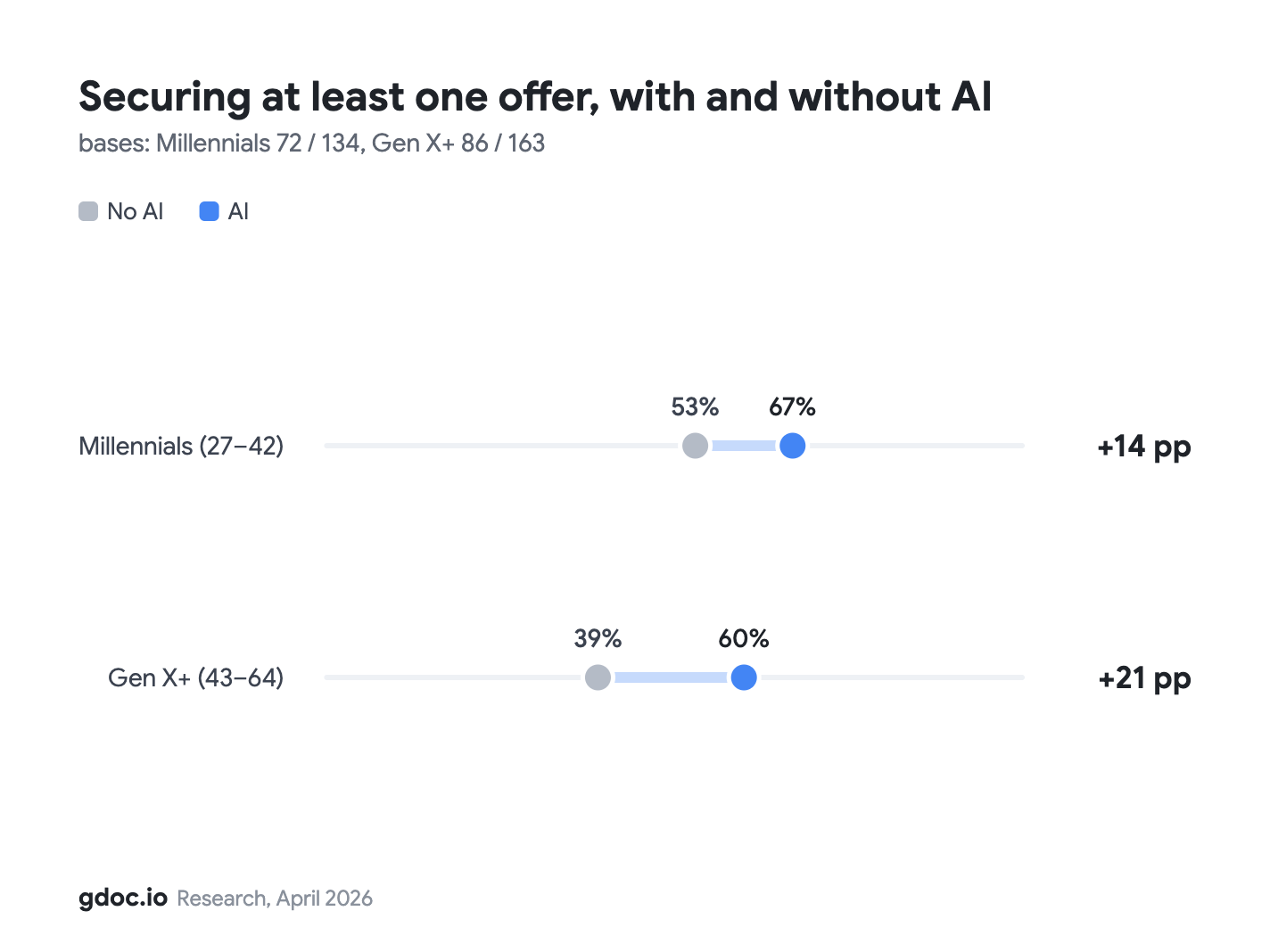
According to a Gdoc.io study of active U.S. job seekers, those who actively use AI are 19 percentage points more likely to secure a job offer (66% vs. 47%). But the gap is uneven across age groups: among Gen X+ (43–64), AI users’ offer rate is 54% higher than non-users’ (60% vs. 39%), compared with 26% higher among Millennials (27–42; 67% vs. 53%).
Key findings from 500 U.S. job seekers (April 2026):
- Gen X+ (43–64) targets mid-level roles more often than Millennials (40% vs. 34%)
- After age 43, AI users are 50%+ more likely to land at least one offer (60% vs. 39%)
- 61% of the Gen X+ who opted out of AI received no offers
- AI-savvy job seekers are more likely to land job offers: 66% vs. 47% across the sample
- 66% of Gen X+ AI users never tell an employer they used it – against 43% of Millennials
Career path: Gen X+ job seekers favor mid-level roles more than Millennials (+6 pp)
When it comes to the roles candidates pursue, a clear generational divide emerges. Gen X+ (43–64) gravitates steadily toward mid-level positions – 40% versus 34% for Millennials.
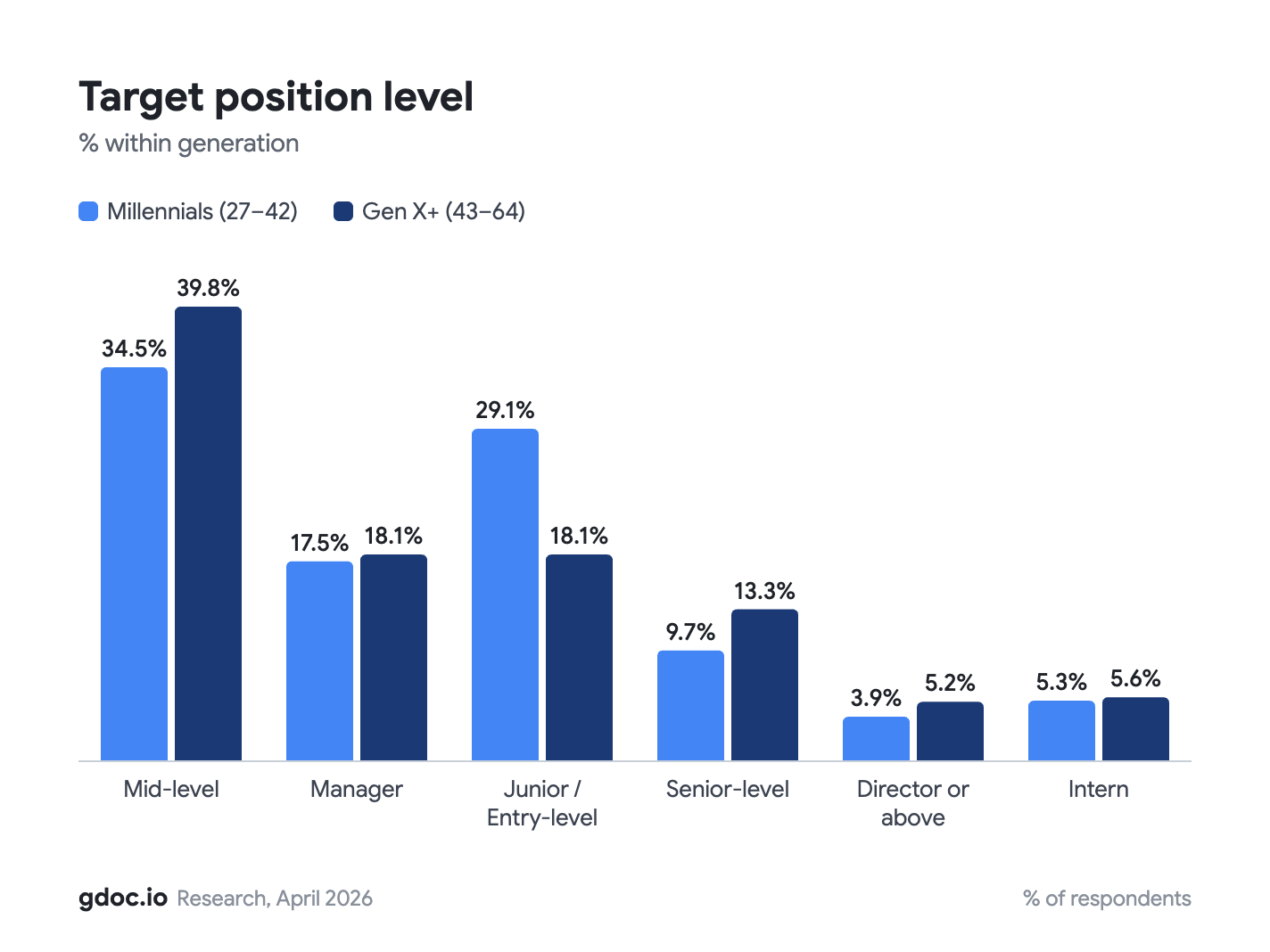
Gen X+ is rarely chasing entry-level openings – 18% versus 29% for Millennials. This reflects accumulated experience: by ages 43–64, many professionals have already progressed beyond junior roles; they advance laterally or pivot into adjacent fields without taking a step down the career ladder. Older candidates are only slightly more likely to target senior and director-level roles. The clearest generational divide emerges in the mid-level tier, where competition is fiercest.
After age 43, AI users are 50%+ more likely to land an offer
35% of Millennials and roughly 35% of Gen X+ use AI in their search – the adoption rates are closely aligned, but the outcomes split radically.
Among AI-assisted Millennials, 67% landed at least one offer versus 53% of non-users (a 14-point gap). For Gen X+, the effect is even more pronounced: 60% of AI users secured at least one offer, with only 39% for non-users (a 21-point gap). In relative terms, AI users in this group were more than 50% more likely to land at least one offer than non-users – and 8 in 10 believe AI made their applications stronger.
Below is an expert opinion from John K. Brubaker. Brubaker, a Yale graduate with nearly four decades in talent acquisition, professional resume writer and job coach, has run the Professional Resume Plus service since 1989. He has been a prolific commentator on the recent industry dynamics.
“Job search is often a very fear-inducing experience. When people get into job search and they tell somebody ‘I’m doing a job search,’ they’re going to hear things that are stated as absolute fact that are just negative: we’re about to head into a gigantic recession, and so on. Focusing on fear-based perceived negatives is counter-productive. Mental strength and persistence are qualities that good job seekers have in common.”
61% of Gen X+ job seekers receive no offers without AI
Job hunting turns into a grinding marathon with long odds for AI non-users in the Gen X+ cohort. 61% of Gen X+ who don’t use AI receive no offers at all, against 47% for non-AI Millennials.
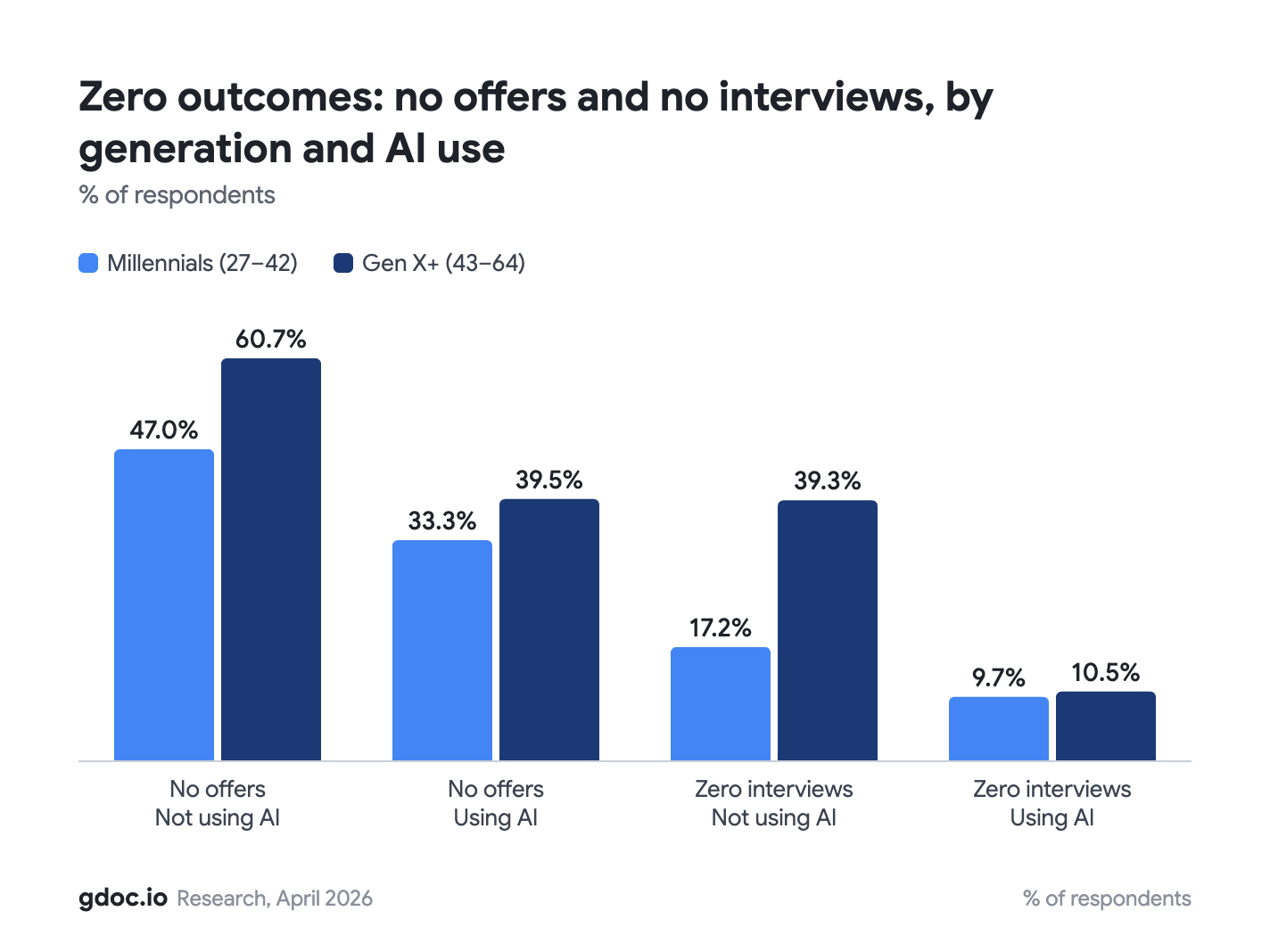
The zero interview rate is telling: without AI, 39.3% of Gen X+ respondents never received a single first call – against just 10% for AI users (a four-fold gap). The Millennial cohort also reveals a meaningful gap: 17% without AI versus 10% with AI.
AI doesn’t just raise the odds of an offer – it fundamentally changes the trajectory of the search. Candidates who tailor their resume to each posting make shortlists more often. That means more first interviews and a faster first offer.
AI users are about twice as likely to land multiple offers
The picture becomes clearer when the focus shifts from receiving an offer to the number of offers received. Among Millennials, 49% of AI users landed two or more offers versus 26% of non-users; among Gen X+, 44% versus 18%.
| Number of offers | Millennials (27–42) | Gen X+ (43–64) |
|---|---|---|
| 0 – with AI | 33% | 40% |
| 0 – without AI | 47% | 61% |
| 1 – with AI | 18% | 16% |
| 1 – without AI | 27% | 21% |
| 2–3 – with AI | 39% | 36% |
| 2–3 – without AI | 21% | 15% |
| 4+ – with AI | 10% | 8% |
| 4+ – without AI | 5% | 3% |
The two-to-three-offer band shows a clear pattern: 39% of AI-using Millennials fall into this category, compared with just 21% of non-users – nearly a twofold difference. For Gen X+, the gap is even wider: 36% of AI users receive two to three offers, compared with just 15% of non-users – more than double the share. The highest tier, four or more offers, is reached by only 3% of non-users, versus 8% of AI users.
“Number one, the AI users are likely to be using AI in an effective way that is helpful in their job search, giving them an advantage over the non-AI user. But secondly, if you did a statistical sampling, you would find that the people who use AI, broadly speaking, have better, stronger, and more diverse technology skills and have a history of leveraging technology to help businesses grow and improve efficiency. So there’s a self-selecting factor – those candidates are simply more attractive.”
AI-savvy Millennials view job search more positively, Gen X+ shows flat results
The U.S. labor market has shifted. Job seekers admit the search process is growing increasingly complicated, and AI use is becoming a key facilitating factor.
52.8% of AI-savvy Millennials view the job market neutrally or positively, versus 45.5% of non-users (a 16% relative advantage). By contrast, for Gen X+ the difference is negligible: 44.2% versus 42.3%. 57.7% of Gen X+ respondents who do not use AI perceive the job search as harder or much harder than in previous years.
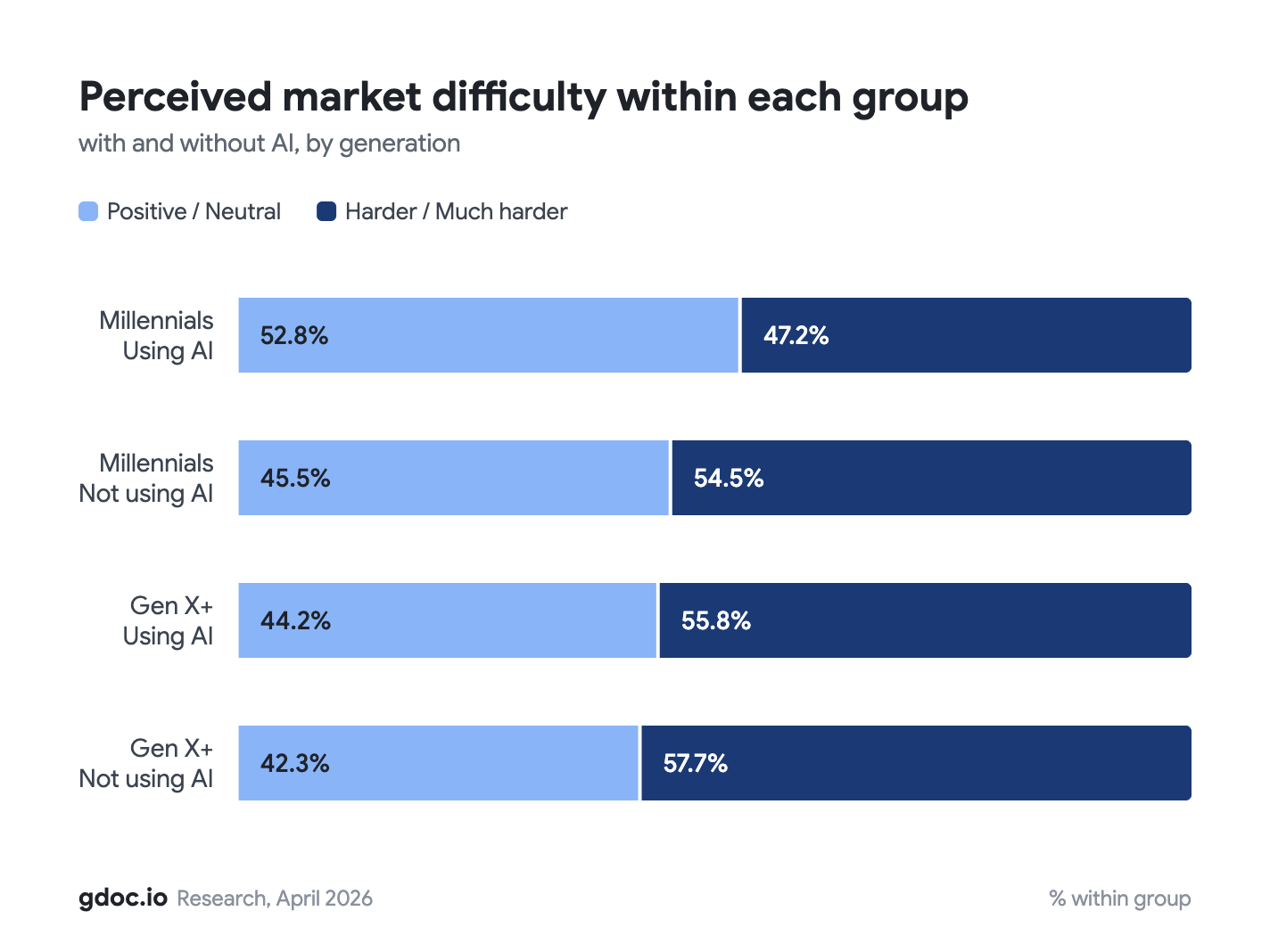
Gen X+ job seekers with and without AI are equally gloomy about the job market. Yet those who use AI still land offers far more often.
66% of Gen X+ AI users conceal AI use from employers
Roughly 81–82% of AI users in both generations believe AI tools improved the quality of their applications. However, there is a significant generational split when it comes to disclosing AI use to employers.
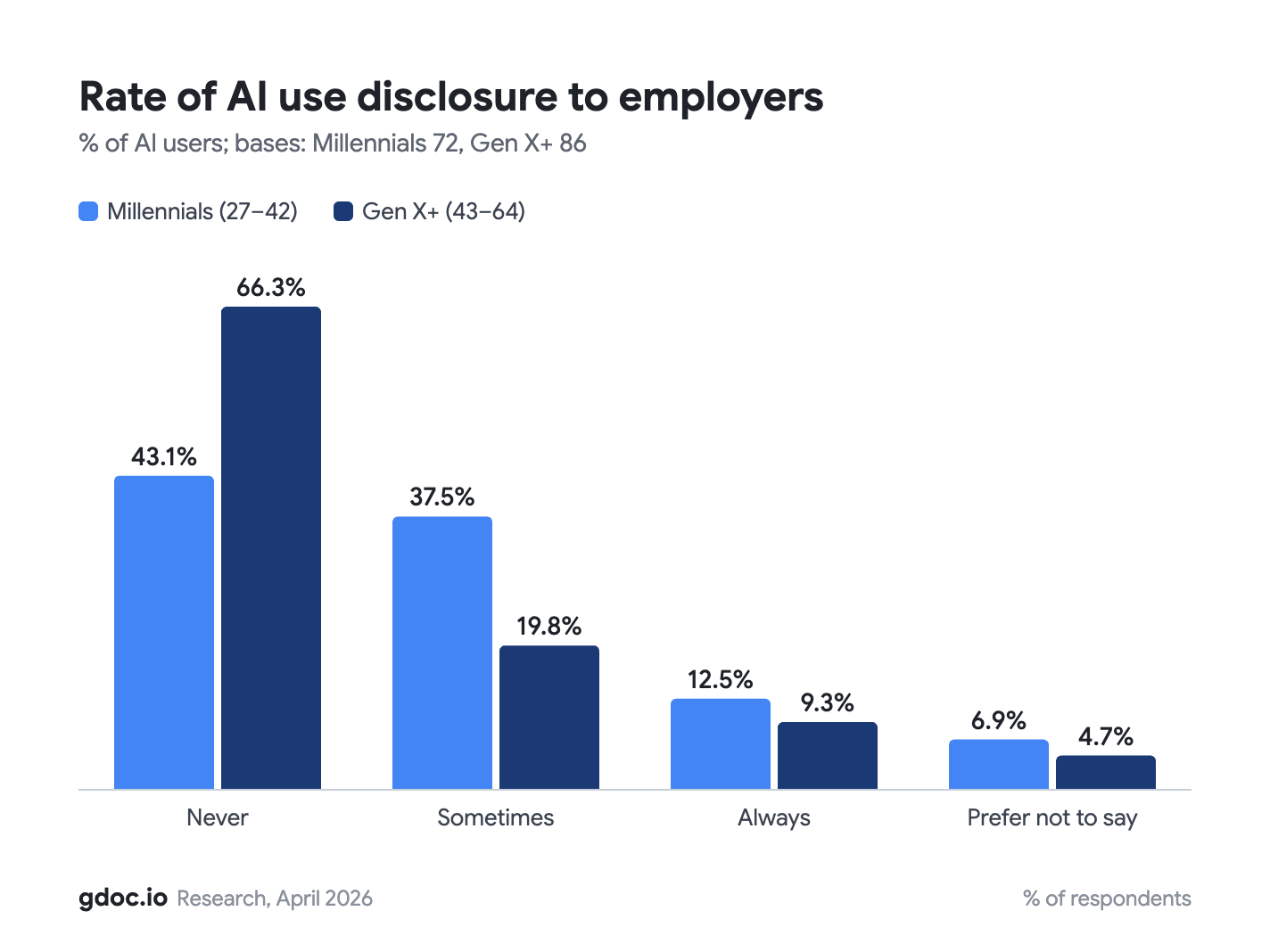
Gen X+ is far more likely to withhold disclosure: 66% never mention AI use to an employer, against 43% of Millennials. Millennials, by contrast, are more willing to situationally acknowledge AI use – 38% may bring it up on occasion. The gap suggests different standards of transparency across generations, with older candidates more inclined to remain silent.
Notably, both groups consider AI use ethical, whereas concealing AI assistance appears merely pragmatic: the industry hasn’t settled on a norm so candidates would rather not take the risk.
“The answer I recommend to candidates is honest: I do not use AI to write my original content – I put a lot of my own information, my own specifics, my own examples in there. But I do use it for customizing my resume for a particular position, and I find it’s very useful. At the same time, I tell people: if you aren’t using AI, you’re making a huge mistake. And if you’re overusing AI, you’re making a huge mistake.”
METHODOLOGY
Gdoc.io conducted the study in April 2026 via the Pollfish platform.
Sample: 500 U.S. adults (ages 18–64) who had been actively job hunting in the previous 12 months: Gen Z (18–26, n=45), Millennials (27–42, n=206), Gen X and older (43–64, n=249).
This article compares Millennials and Gen X+. AI users: n=179; non-users: n=321. The study identifies correlation rather than causation.